Friday, October 8, 2010

When a game's ending moves you...


In-between updates on what I think about the design process in gaming, I do my own research on what constitutes good and bad game design. Of course, "research" amounts to playing the newest releases for myself, and enjoying the fruits of a developer's labor.

Every so often though, a game I play forces me to take pause...to take a moment of silent contemplation at what I have just witnessed.

Enslaved: Odyssey to the West is one such game.

Now, I'm not going to spoil what happens at the end; that would just be cruel. What I will say though, is that the game got me to thinking an awful lot about the nature of humanity, and what right humanity has over this world, exactly. Do we have the right to preserve our way of life, even after that way of life has long ago become forgotten and irrelevant?

Let me explain, without being all spoilerific. Enslaved is a game that takes place some 150 years after most of humanity has been killed off by an unmentioned apocalyptic event, most likely a war of some sort. Amongst the few human survivors, most of what remains of the old world of humanity are robotic sentries, or "mechs". They are old war machines that know nothing else but killing, or enslaving, what few humans are left. The human beings these machines are able to capture are fitted with slave headbands that force them to obey the machines' will, or else the headband will kill them.

A brutish loner named Monkey is captured on one of the mechs' slave ships, and is accidentally freed when a young, tech-savvy girl named Trip hijacks the ship in an attempt to escape. Monkey and Trip both escape the ship, landing in the beautiful, forested ruins of New York City. The escape leaves Monkey unconscious after their escape pod crashes into Grand Central Station, but when Monkey awakens, he finds that Trip has affixed one of the slave headbands to his head, and that he is now under her control against his will. Trip tells Monkey that if he wants the headband removed, that he will protect her, and take her 300 miles to the west, to get her back home. Thus begins the pair's "Odyssey to the West".

The game is actually based off of the old Chinese story published in the 1590's during the Ming Dynasty, Journey to the West. In that story, there is the Monkey King, his companion Tripitaka, and their pilgrimage to India. While the video game Enslaved is only loosely connected to the original Chinese story, the game itself tells such an interesting story, and wound up going into a direction I never would have expected.


The destroyed, re-naturalized landscape of an America nearly devoid of human life is captivating, haunting, and utterly beautiful all at the same time. The opening few chapters of the game depict Monkey and Trip's travel through New York City, and all around you, memories and images of the world that once was stand proud and tall, toppled and broken, but covered in life. Skyscrapers that haven't even been built yet in our present world stand emptied and covered in ivy and ferns, with trees having grown out the sides, vines connecting the ravaged buildings into an enormous, green canopy of life. It's beautiful....but sad.

And that brings me to the game's ending, which again I simply cannot spoil. Rather than being what I expected, a gigantic showoff against humanity's common enemy, the entity behind the mechanical destruction of the human race...I found something wholly different. Something that brought me pause, that stole the words from me.

I cannot look at our world, and say with any certainty that if we were to lose our chance to sustain ourselves, that we would really deserve another opportunity to correct those mistakes. What we have is beautiful, it is impressive, it is incredible that we have gotten this far at all...and yet it is all so precarious. If it is lost...then it is lost. The past will be the past, and may best be forgotten. Trying to keep that past alive is a fool's errand...and the best thing to do, perhaps, is to just put it out of its misery.

This game's ending brought that thought to me, that maybe while our present (Which is the game's past) is grand and full of wonder, that maybe it is only a brilliant flash of lightning in the cosmic sense. Maybe all we are is just a flash in the pan, a piece of the Earth's history that is fleeting, beautiful, but meant to die. Sobering...but possibly true.

Can we really sustain ourselves, without the Earth stepping back in due to our failure, to reclaim what was once its own? Do we have the right to sustain ourselves? Are we only delaying the inevitable?

....And they say video games aren't art? HAH!

Seriously, if you have a PS3 or XBox 360, go and buy this game. Now.

Enslaved: Odyssey to the West. Wow, what a game!

Liquid Design

Water, water, everywhere. That about describes the situation in most video games, where water and other liquids make for interesting permutations in gameplay and visual design. Even the earliest days of video gaming made use of water as a part of gameplay, primarily to denote the places your character can be killed.

Super Mario Bros. comes to mind for one of the earliest games I can remember from my own childhood, where water was a bad thing. The funny thing is how I never noticed until just recently that, due to hardware limitations, water on your average side-scrolling Super Mario Bros. level is a painted-on decal. If you should fall into a hole or trap where you can see water, you simply fall as if the water was never there to begin with; it was just a cute way to make a death trap look more fancy than it actually was.


Super Mario Bros. took things a step further though, by introducing levels to mix up the standard platforming in which Mario could actually SWIM. Yes, it was revolutionary, it was fun, and it really did provide a welcome distraction from all that running to the right and goomba stomping. As I can personally attest to, my own brother's 4 year old step-son loves the water levels; every time I manage to get to one, he is very quick to grab the controller, and ram me into a blooper squid, or one of those mindless fish. Thanks, Vinny!

The usage of water in video games has long been a staple of gameplay, and has become ever more so in the years since I first picked up a controller. I can still remember the frustration I felt on the water level from Earthworm Jim. I'll never forget the panic I felt as I ran out of air, desperately searching for an air bubble in the watery zones from Sonic the Hedgehog games (like Labyrinth Zone, Chemical Plant Zone, Aquatic Ruin Zone, Hydrocity Zone, etc).

With the advent of 3D graphics, the use of water seemed to take on a different kind of meaning; it went from a gameplay mechanic, to a benchmark of sorts. The complexity of water in a three dimensional space meant that, at least for awhile, the better-looking a game's water, the better the game. A shallow way of looking at a video game of course, but for an 11 year old marveling at 3D graphics for the first time in 1996, the alluring flow of digital liquid felt so amazing to see. Flat textures, ground and grass textures and the rest just weren't as impressive...but the water was a crystal-clear pool of possibilities. Perhaps the first game that sparked this sensation was again a Mario game; Super Mario 64.


Of course by today's standards, Mario 64 isn't anything too terribly impressive. At the time, stepping Mario's foot for the first time into that invitingly calm water in Jolly Roger Bay felt like a revelation, and then came the actual fun when you learned to swim in a three dimensional space. And there was so much to DO underwater, and so much room to move! The way that game handled water just felt right. The actual way a game handles water in a three-dimensional sense is far more complicated than it had been in a 2D game. For a game like Sonic the Hedgehog, water involved an effect painted over a portion of the screen, in which anything behind that effect would appear tinted blue. Bubbles would rise from the bottom portion of the screen to the top, and the physics of jumping, momentum, and speed were altered. You could jump higher, but your speed was handicapped; it was a different sensation, it changed up the gameplay, but in the end it was just an effect that the system cooked up to make the player feel more immersed. The objective, even in those watery levels, was to get out of the water and keep moving to the right.

With Super Mario 64, water felt more real than it ever had before. It became an animated, ebbing and flowing surface that contained its own fluid dynamics, that presented concepts like buoyancy and current. Mario could swim in ANY direction; not just up and down, left and right. We had real, true depth to worry about now. Things could be obscured or hidden by the silt in the water, and added a layer of exploration and discovery to the underwater world. In fact, one of the first objectives in the watery world of Jolly Roger Bay had Mario, and hence the player, discover and then finally enter a sunken ship to discover a hidden power star. The entire experience felt completely different from how water had been treated in games previously, in which the objective of water levels was either to get as far to the right as possible, or to simply avoid the water altogether.

Water was quickly coming into its own as a gameplay mechanic, but it could still go further. As beautiful as the water in Super Mario 64 was, it was static. It could not splash, it could not fluidly MOVE unless it was programmed to do so in a specific, pre-determined path. A waterfall, for example, had to be a specially-programmed object in the world, coated with a texture that made the solid object appear as if it were moving water, when in reality it is only a visual effect.

Mario's next game, conveniently enough for this subject, was ALL about water and liquids and fluids. Super Mario Sunshine is a game in which Mario's acrobatic repertoire of moves is replaced by a backpack watering unit called FLUDD. With this backpack, Mario has to clean up after Bowser Jr, after he coats the picturesque vacation spot of Delfino Island in goopy paint. Not only is the paint a liquid new to gamers at the time, but the ways in which the paint was removed proved a great way to make a Mario game fun.


The water splashed, it sloshed, it sprayed, it flowed, it did all of the alluring yet simple things a fluid is supposed to do, and at the same time all of it was directed squarely at gameplay. FLUDD could spray water straight ahead, it could use water to suspend Mario in mid-air, like a hovering jetpack. It could use water to propel Mario at crazy speeds across the surf, it could propel him deep underwater, and it could even let Mario jump ten times higher than normal in a supercharged burst of water pressure! Water was no longer simply a tool to change the pace of gameplay; it had BECOME the gameplay. And true to 3D's use of water proving as a graphical benchmark, Mario Sunshine's water was appropriately beautiful to look at; it sparkled, shimmered, and looked warm to the touch. Everything about it screamed "Play with me! I'm fun!". And despite Mario Sunshine being considered a low point of the main Super Mario platformer franchise by many, Mario Sunshine was still a damn fine game, in large part because the water really was so much fun to mess around with.

Where did water have left to go? What more could it do for us, to enhance and change the way we play? The answer would come in a 2007 title developed by Irrational Games, Bioshock. Water was going to take on a whole new meaning, not to mention a whole new level of beauty and sophistication.

Bioshock is the tale of paradise lost beneath the ocean; the city of Rapture, designed by the most brilliant minds on Earth as a means to escape the expectations of the land-based nations of the outside world. As scientific practice continued unhindered by the troublesome ethics and morals of the outside world, genetic engineering gave birth to a new kind of drug unique to Rapture; a tonic that could rewrite genetic code, known as a "plasmid". These plasmids could grant an ordinary man the powers over electricity, or give him the ability to lift objects from a distance with nothing but the power of thought, just to name a few. Although the plasmids had the potential to turn ordinary men into superhumans, the drugs had a terrible effect on the populace of Rapture however, twisting their minds and bodies until they became nigh-unrecognizable as human beings; they became known as splicers. And as the city of Rapture fell apart, its citizenry tearing each other to pieces, the city began to buckle under the pressure of thousands of feet of water...and the city began to flood.

Water in Bioshock is pure atmosphere, and rather than providing an entertaining distraction or fun gameplay, the water in Bioshock evokes claustrophobia and inevitability. That water will continue to seep in; it will fill the city, flood it, and drown all its inhabitants, and all you can do is watch.

I have read in one article, although the exact article escapes me at the moment, that a group of developers at Irrational worked for a solid year on perfecting the way that water behaves. The way it sweeps across a room, or flows in small waterfall-lets down a flight of stairs. The way it soaks into carpet, or the way it refracts the light of fire. The way it can extinguish a burning pile of trash in the corner of a steadily-flooding room, the way it raises and sloshes and sprays and flows...

To show off the wonderful fruits of their labor, a video was even created before the game's 2007 release! Have a look at it below, and see how far we've come from those early days when water was little more than a decal stuck onto the background. There is design in water, and that design has evolved.


I wonder where the next evolution in the presentation of water will take us? If Bioshock, a game released three years ago is capable of such beautiful effects, then what might the future hold?

(Gah, I have no idea why blogger.com decides it's such a great idea to clip YouTube videos like that. Just click on the video, then click again to view it on YouTube, and you'll be set :) )

Wednesday, September 15, 2010

Design in Difficulty


Difficulty is one of the core components of a video game, and one of several components to a game that are unique to the medium, at least in the way it is presented. (By that, I mean a film or book can be considered difficult to read or understand, but only a video game can be literally difficult to DO, in the same way that it is difficult to build a house) Difficulty is a carefully-orchestrated balance between two extremes of simple and relentless, and depending on the genre of game, difficulty can mean a number of things.

Some of the most traditionally-beloved pieces of software are also some of the most difficult, but for varying reasons. Some games are hated simply because they ARE difficult, and are seen as unforgiving and simply not worth the time and effort required to get through them.

Now, when talking about bad design in terms of game difficulty, I would like to take a page from the reviews of the "Angry Video Game Nerd", or AVGN. He is a fictional character created by James Rolfe of Cinemassacre.com, who takes it upon himself to review old games from bygone consoles, and add a borderline-ridiculous amount of expletives into the mix, to make his frustration with gaming's past that much more palpable. The reviews are crude, but make a multitude of good points.


One of his earliest reviews, dating back to around 2007, is of the game Dragon's Lair, for the NES. Dragon's Lair features some of the most perplexing, anal, ridiculous mechanics of any game I can think of, and the sheer difficulty in coping with the way the game forces you to play it makes it a prime example of horrible design. In short, if Dragon's Lair did it, you don't want to put it into your game. There is no logical reason to make your players suffer like that.

For instance; why does the main character, Dirk the Daring, even have a life bar if something as simple as touching a wooden door can kill him? See the wooden drawbridge door in that picture just above? Stepping into it will kill you instantly. The only way to open the door is to kill the dragon, and yet the only way you can kill the dragon is by ducking and throwing knives. But when you duck, the dragon ducks, too! So you are forced to alternate between standing up so the dragon puts his head up, and ducking and throwing a ton of knives. It's pointless, and it isn't fun. The entire time, there is a small bird that flies at you, and if it hits you, it takes a piece off your life bar; EVERYTHING else in this screen (The dragon, the door, falling in the water, getting hit by the dragon's fire breath) will instantly kill you. This is typical through the entire game, as enemies and hazards in the game are, for whatever reason, divided into things that kill Dirk instantly, or take a piece away from his life bar. During the Nerd's 15 or so minute review of the game, he was only able to make it through a single door, and into a second room, where he died. That's all the further he was ever able to make it.

The difficulty of that game was designed arbitrarily, without care or reason, and resulted in what is unquestionably a pain to play. I've tried it myself; it's HORRIBLE! Playing a game like that makes me wonder exactly what the developers were thinking when they made it, a question the Nerd frequently finds himself asking his viewers. The answer? I don't know. Maybe it's because the game was created before a heretofore meaningless subject like the difficulty of a video game became the subject of serious thought and discussion?

For every game like Dragon's Lair that didn't understand the concept, there are those that mold the idea of game difficulty into an art form. They understand that difficulty should be a progressive affair, and that difficulty can be used as a tool to drive a player forward.


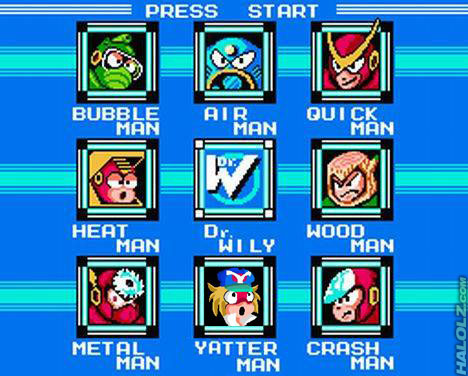
When I think of a game that is difficult and yet FUN, I think of Mega Man 2, in particular. The game is a culmination of all things that make this medium so engaging, from its incredibly well-orchestrated chiptune music and iconic graphics to its perfect balance of fun vs. difficulty. The game is HARD, don't get me wrong; I have never managed to beat it.

For those who don't know how an NES-era Mega Man game works, you have 8 different robot masters, who each control their own themed level (Air Man has a stage set in the clouds, Metal Man's level looks like an iron foundry, etc), who can all be fought in any order. Each robot master has a power-up granted to the player upon their defeat, and this item is also themed after the elemental nature of the different robot masters (Metal Man gives you Metal Blades, Air Man gives you Air Gust, etc). Once all 8 robot masters are defeated, access is granted to the final series of levels, which culminates in a showdown with Dr. Wily, the mad scientist behind this whole robotic army.


The catch with Mega Man 2, as well as all other NES-era Mega Man games (There are 6 in total), is that each boss has a weakness. Metal Man is weak against Mega Man's default blaster, and so should be tackled first. He gives the Metal Blades, which Air Man is very weak against; so you should do Air Man's level second. Air Man will then give you another weapon that another boss is weak against...and so on, and so forth. Challenge is derived not just by playing the levels and bosses in a specific order, but by creating even more difficult challenges without actually being prompted to do so. Want to brag to your friends that you beat Crash Man with nothing but the default blaster? You are allowed to try, but it will be frustratingly difficult! The reward for doing so however, is to be considered an excellent player of the game. Why do people do it? Because they can, and because it's fun!

Dragon's Lair did not understand this; the game was unreasonably difficult, and there was no way to actually play WITH it. Either you play by its rules, or you throw the game in a garbage can and light it on fire, like the Nerd did.

Game players like to make their own rules, their own challenges, their own fun. Ever wonder why the Grand Theft Auto games are so popular? THIS IS WHY! The violence is part of it, but THIS is the real reason! The games are freeform sandbox playgrounds, that let you do anything you like. I can remember spending hours just trying to see how high and far I could fling a sports car off a ramp, just because it was so fun to tinker with it. These games can be as easy or as difficult as you want them to be, really. Want to impress your friends by getting the police so agitated that they send the *military* after your character, and yet you are still able to survive? You can. Want to take the easy way out of a difficult mission by finding a helicopter and flying over the tough parts? You're free to do so. Want to just do what the game suggests you do, and take the moderately challenging way through? Go right ahead.


A recent evolution of the way video games present difficulty is embodied in a PlayStation 3 title, Demon's Souls. An unassuming Japanese title, Demon's Souls presents a world covered in a thick grey fog. The fog steals men's souls, and resurrects them as demons, corrupted by hatred for all things still living. They are lorded over by the Archdemons, who are in turn brought into existance by the ancient god, known only as the "Old One". He must be lulled back into slumber for the crisis to come to a close, and it is up to you to do so.

The game is punishingly difficult...but not without reason. This is one of the few games that forces you to play by its rules...and yet it feels fair. If you die, it can ONLY be your fault. The game did not trick you, it did not overwhelm you out of nowhere, it did not pull the rug out from beneath you and cackle as you rip out what little hair you might have left. Because the game does not trick the player into death, players learn from their mistakes by repeating their deaths, and are given incentive to learn the layout of the worlds they traverse. The more you play, the better you get; not because you got lucky, but because you became wise. Each Archdemon has a pattern that can be learned and taken advantage of. Each world has secrets that can be uncovered to those who are persistent, such as shortcuts and useful items. They make the game *easier*, as a reward for patience and care.


This kind of difficulty culminates in what might be the most unique award I have ever felt by playing a game, and is a testament to how a video game can evoke emotion. When you face a dragon in this game, it is an enormous beast that could take a thousand arrows, maybe an hour and a half of your time, to kill...but when you finally beat it, and know that it was by your skill, by your patience, determination, and wit...you feel like the king of the world. You are not simply some gamer pushing buttons and dealing with arbitrary rulesets. You are a DRAGONSLAYER.

That, ladies and gentlemen, is GREAT design.

Thursday, September 2, 2010

Out of slumber, and back into the world of interactive art!


It's been quite awhile since my last post here, but the time has come for the sleeping blog to wake up and smell the bacon. This blog will again shift gears, no longer confined by the needs of a college class to keep it so narrowly focused. Even during that class (And much to my professor's chagrin), I felt difficulty focusing entirely on one single aspect of the multi-headed hydra that is the video gaming world; there is simply too much ground to cover. A blog without at least SOME focus is of course a bad thing, and so from here on out this blog will be dedicated to a more open topic; design.

What is design? I'm not about to quote Webster's, since design can count as virtually anything that can be seen, felt, heard, or experienced from within any given thing. Design is a scene carefully orchestrated by its creator, to evoke fun, frustration, anger, joy, and all things in-between. It encompasses writing, visuals, music, and even the psychology of how a player interacts with the game. There is good game design, and bad game design, just like there is good and bad design in anything else.

This blog will focus on design, and what it means for a video game to have both good and bad design. What can we appreciate about the good, and what can we learn from the bad? Is there such a thing as overdesign? Is there something to be loved about a game with poor design?

I'm going to delve into it, and shed some light on as many aspects of it as I can!


On a side note, typing the word "design" so many times in such a short time makes the word look and sound awfully funny!

Sunday, April 25, 2010

What does a flower dream of?


Nature is beautiful, that much is obvious. How often do we stop to take it in, and to think to ourselves that were those plants capable of dreaming, that their dreams might be just as much so? What does a flower dream of, while trapped inside a drab, lifeless apartment in the middle of a city? Not one hint of green, or of life at all, can be seen anywhere. The flower is isolated, starved, hungry...so it dreams of a perfect land, where nothing exists but grass, the sun, and the gentle caress of the wind.

This is Flower, the very latest work by thatgamecompany, also responsible for the PlayStation Network title, flOw. An artistic powerhouse, thatgamecompany finds beauty in simplicity; the concept of Flower, along with the gameplay, can not be simpler.

You play as the wind itself, and by merely tilting the controller (Taking advantage of the motion control therein), you direct the wind. Every button on the controller does the same thing; makes the wind blow.

You start each level (Represented by the dream of a different flower) in a nigh-endless field of gently-swaying grass. There is a single flower...and as you blow the wind, a petal comes loose. It bobs and floats along with the breeze as you guide it...bringing it to other flowers, each flower letting loose a petal and a single musical note, slowly transforming your gust of wind into a force of nature, able to bring light and life to even the darkest corners of the Earth. You light the darkness...you touch nature itself, and breathe it back into shape. One flower at a time, you make the world into a paradise.

The beauty of it all is that it feels so effortless, so calm and serene; each level offers a unique take on the powers that your wind can bring to the world. One level features windmills that let you dance across the level, blazing a trail of flower petals. Another features small, glowing flowers that, when spread about by your wind, can light up the night. Still another features a special kind of flower petal that allows your wind to paint the grass an array of starkly beautiful colors, from purple to yellow to red.

Take a look at this video for Flower, and you'll see what I mean! Simplicity is beautiful in many art forms; some of the very best photographs or movies feature the most mundane of subjects, and yet...that is their best quality. Flower is no different!

Why do we kill in the name of good?


(4/25/2010) One of the beautiful things about video games, as well as other forms of art, is their ability to question the nature of people, of systems, of nature and life. Why do we do terrible things in the name of good? To what end does that bring us? What is the nature of a good deed, anyway?

Fumito Ueda and his development team, TEAM ICO, decided to tackle these difficult questions not in the form of a concrete answer, but in the form of a video game crafted with what can best be described as a forlorn love for the medium. That video game is Shadow of the Colossus, for the PlayStation 2.

Amidst the ruins of a lost, ancient race of unknown beings, a man on a horse strides along an elaborately-built bridge on a horse, carrying little more than short sword, a bow, and a woman's lifeless corpse. He has come to this forsaken, empty land in search of a way to bring his beloved back to life.

The land he and his horse tread upon feels sacred, tranquil, and untouched by humankind for centuries at the very least. At the end of a long, lonesome travel, the man enters a temple seemingly forgotten by time, where butterflies rest along flowers pushing from out of cracks in the old stone of the temple's walls. He rests the woman on a large pedestal at the open end of the temple, blindingly bright sunlight pouring warmth onto the pair, as a gentle, powerful voice echoes through the temple. It speaks in some ancient, forgotten language, telling the young man that if he wishes to bring his love back to life, that he must take the lives of twelve colossi that roam the empty wilds surrounding the temple. They are the only adversaries in the entirety of the game; what amount to twelve boss battles.

Each of these incredible creatures, innocent and gentle beasts that look older than time itself and have done no wrong, are to be toppled by the young man's blade, his bow, and his wits alone; there are no other tools. How exactly do you kill a mountain? And when you do, what consequences are there for taking their lives? As you climb the beast, the music drives you forward, arriving in a crescendo of freedom, an exhilarating sense of euphoria as you conquer the massive creature! You almost forget that what you're doing is wrong...and with each kill, the man loses more and more of...something. The music feels sad as the being topples to the ground, felled for no reason other than the fact that it was an obstacle in the man's way. It is dead, and your only reward is to see the ethereal tendrils of the colossus' soul writhe through the air, finding the one who had done the deed, diving down to the ground and pushing through into the man's chest. Exhaling a spirit-tinged breath, the man collapses to the ground, unconscious.

He awakens again inside the temple, and is given the location of the next innocent creature he is to slay. The cycle repeats.


TEAM ICO is famous for their artistic minds, and this is saying quite a bit considering that the team has only developed two games to date, Shadow of the Colossus being the second of these two. The first game, ICO, is not only the namesake of the developer, but is an equally artistic, beautiful tale of a boy with horns trapped in a labyrinth. His only companion is a ragged princess who speaks an ethereal foreign language, and yet she depends upon the boy to lead her to safety, and to protect her from the shadows that lurk around the labyrinth. Your only weapon, similar to the "hero" in SOTC, is a stick. There are no flashy menus, no fluff or sidequests, and barely any narrative to speak of. It is through this minimalist style that TEAM ICO has crafted their own identity from ancient stone and mythic wonder. These are not games in the traditional sense, and yet they are some of the best the medium has to offer.

The future is looking bright for Ueda-san and his team too, as later this year, the team is looking to bring The Last Guardian exclusively to the PlayStation 3. While little has been revealed of this game so far, it will be the third in TEAM ICO's library, and looks to be a fusion of what can be found in the team's two previous games. The story concerns a young boy, very reminiscient of the main character in ICO, who befriends a large, yet friendly gryphon-looking creature named Trico. Personally, considering the sheer beauty and emotional depth that TEAM ICO's two previous games have held, to say I am eager to get my hands on this newest effort would be an enormous understatement!

Take a look at these two videos! The first is a trailer for Shadow of the Colossus, and the second one is a trailer for the upcoming The Last Guardian. Enjoy!


Sunday, April 18, 2010

The Heavyweight Challenger...Roger Ebert


I once heard a great line from the Pixar film Ratatouille, if I may paraphrase. The life of a critic is an easy one, simply being able to tell people what is good and what isn't, and to be able to rely on one's own taste to give people advice. The one area this is not the case however, and where critics take risks, is in the discovery and defense of the new. By defending what is new in the eyes those hoping to judge hotly controversial material, be it food (And its tiny rat-chef) in the Pixar film, or be it a budding and developing art form as it is in the case of video games.

I might not be a critic, but I stand my ground and defend what I love even when it is relatively new and unproven in the eyes of traditionalist critics. Why do I do it? I'm not quite sure I can answer that fully, but the closest answer I could give is that where there is passion, there is appreciation. Where there is appreciation, there's a desire to see that appreciation reciprocated by others with like minds, a community formed, and a usage of that community to make the object of passion that much better a thing to present to the world.

Roger Ebert has my respect; he is a man who seems to have sampled the world, in much the same way as the antagonistic food critic in Pixar's Ratatouille had. He has an awful lot of credibility to say the very least, and his opinions have had the power to make or break a feature film's success in the box office. He is one of the titans of criticism and as such, when he speaks, people listen.

Some years ago, Roger Ebert had posted an article on his personal blog, stating that he did not believe that video games will ever be as artistically worthy as movies or literature, although he managed to do so in a way I would call respectable.

His argument is that video games suffer from a limitation on the fundamental level;

"There is a structural reason for that: Video games by their nature require player choices, which is the opposite of the strategy of serious film and literature, which requires authorial control."

I can certainly see what Ebert is going for here, but he seems to miss the point; the fact that gamers can make these choices at all is a direct result of the effort put into the game by its creators. Video games, at least some of them, are often designed with player choice as their bedrock foundation. A game like Heavy Rain, which I had covered in my last post, is so saturated with player choice that the permutations seem almost limitless, and yet every single one of those end results was designed by a living human being with intent on bending human emotions to his or her whims. If that isn't authorial control, I don't know what is!

This argument, however, was a full five years ago. While it is fascinating to debate about, it is ultimately obsolete, especially in the face of Ebert's newest article released just this past Friday, in which he jumps back into the games as art debate.

The article is a fascinating read, in which Ebert goes toe to toe with a game designer defending her own craft as an artform. He debates and gives his own reasoning for his beliefs in a way that, to my eyes, feels warm and inviting. While I could go on and on about this new article, the fact that this article exists at all is proof positive that video games can spark debate as rich as any other medium.

While I respect Mr. Ebert's opinion and enjoy reading his thoughts, I cannot agree with them. Art, to me, is what you find deep inside you when a particular work of human creation moves you. Games do that to me, in much the same way that films speak to and resonate with Ebert. What is important is what we do with those feelings, and how we turn them into something meaningful to the world.

And that is why this blog keeps on going where it's going.